
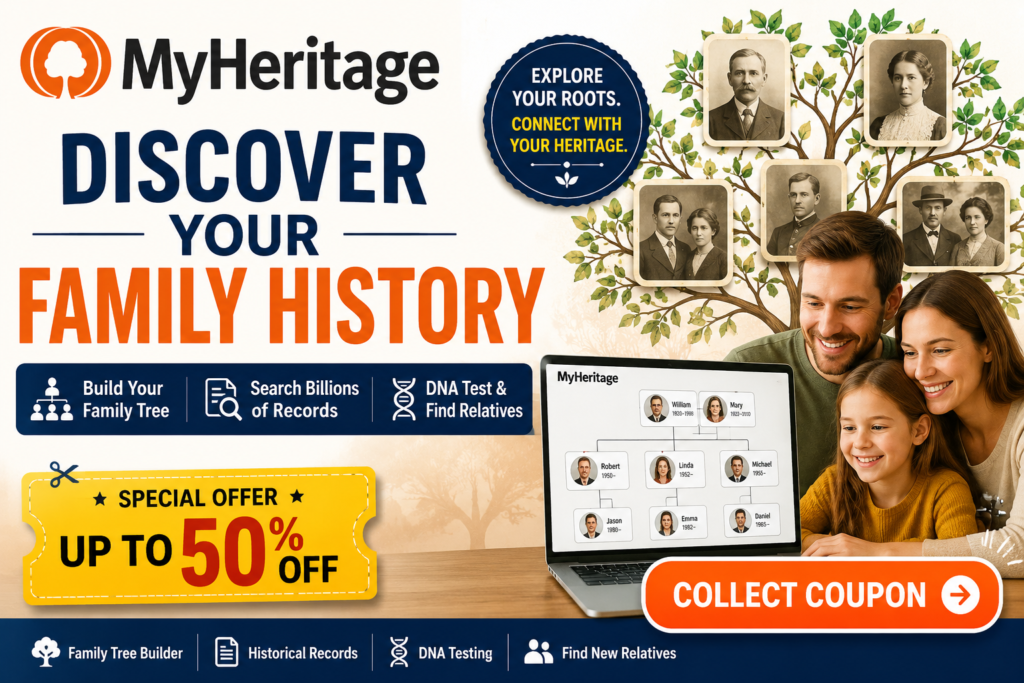
MyHeritage is a popular genealogy platform designed to help people discover, organize, and preserve their family history. With tools for building a family tree, searching historical records, taking a DNA test, finding relatives, and preserving old family photos, MyHeritage brings multiple aspects of genealogy research together in one place.
Whether you are just beginning to research your ancestors or already have an extensive family tree, MyHeritage can help you uncover new connections and historical information.
What Is MyHeritage?
MyHeritage is an online genealogy and family-history platform that allows users to build family trees, search historical records, discover relatives, and explore their ancestry through DNA testing.
The platform offers technologies such as Smart Matches, Record Matches, and other discovery tools that can compare information in your family tree with records and other family trees. MyHeritage also provides a historical records search engine covering billions of genealogy records from around the world.
You can begin by adding information about yourself, your parents, grandparents, and other relatives. As your family tree grows, MyHeritage can help identify potentially relevant records and family-tree connections.
MyHeritage Family Tree
The MyHeritage family tree is one of the platform’s main features. You can create a digital family tree and add information such as:
- First and last names
- Birth and death dates
- Marriage information
- Places of residence
- Photos
- Family stories
- Historical documents
- Relationships between family members
You can also import an existing genealogy database using a GEDCOM file, making it easier to continue research that you have already started elsewhere.
Once your family tree contains enough information, MyHeritage can compare it with other available genealogy information to help identify possible discoveries.
How to Build a Family Tree on MyHeritage
Building a family tree is relatively straightforward:
- Create a MyHeritage account.
- Add yourself as the starting person.
- Enter information about your parents.
- Add grandparents and other known relatives.
- Add dates, locations, photos, and documents where available.
- Review suggested matches and historical records.
- Verify information before adding it permanently to your tree.
- Continue expanding the tree as you discover new ancestors.
MyHeritage recommends building a family tree because tree information can provide additional context for DNA matches and historical research.
MyHeritage Genealogy and Historical Records
Genealogy research becomes much more useful when you can support family-tree information with historical documents.
The MyHeritage historical records search engine includes records covering categories such as:
- Birth, marriage, and death records
- Census and voter lists
- Immigration and travel records
- Military records
- Newspapers
- Books and publications
- School and university records
- Directories
- Public records
- Government, land, court, and wills
- Family trees
- Historical photos and other collections
According to MyHeritage’s current information, its historical-records search engine contains more than 30 billion genealogy records, with additional records added regularly.
Some records can be searched for free, while accessing certain collections and record features requires a paid data subscription.
How to Search MyHeritage Historical Records
You can search using information you already know about an ancestor, such as their name, approximate birth year, or location.
You do not necessarily need to know every detail. MyHeritage allows searches with limited information and provides advanced search options as you enter additional details.
For example, if you know that your great-grandfather was named John Smith and lived in a particular town, you can begin with those details and gradually narrow the results.
MyHeritage DNA Test
The MyHeritage DNA test is designed for genetic genealogy. It can help users investigate their ancestry and identify genetic relatives through DNA matching.
MyHeritage says its DNA test provides two primary types of results:
- Ethnicity Estimate — an estimate of your ancestral origins.
- DNA Matches — potential relatives identified through shared DNA.
The company describes the MyHeritage DNA kit as an autosomal DNA test for genetic genealogy.
DNA testing can be especially useful when combined with a traditional family tree. Your DNA matches may provide clues about branches of your family that are difficult to document through historical records alone.
MyHeritage Ethnicity Estimate
One of the most interesting parts of a MyHeritage DNA test is the Ethnicity Estimate.
The results can provide estimated percentages associated with different ancestral populations and geographic regions. MyHeritage currently advertises coverage across 2,114 geographic regions.
However, an ethnicity estimate should be understood as an estimate rather than an exact measurement of your identity or family history. Genetic ancestry databases and algorithms can change over time, so results may also be updated as the underlying technology and reference populations improve.
MyHeritage DNA Matches
DNA Matches are another important part of the MyHeritage DNA experience.
If another person shares enough DNA with you, MyHeritage may identify that person as a potential relative. These matches can sometimes help genealogists discover:
- Unknown relatives
- Previously undocumented family branches
- Common ancestors
- Connections between different family trees
- Clues about biological relationships
The greatest value often comes from combining DNA matches with documentary genealogy rather than treating a DNA match as proof of a specific relationship by itself.
Why Combine a MyHeritage Family Tree With DNA?
A family tree and DNA results can complement each other.
Your family tree provides documented names, dates, places, and relationships. DNA provides genetic evidence and potential connections with other people.
MyHeritage specifically explains that a family tree can help improve the usefulness of DNA results by providing more information for relationship estimates and helping users trace DNA matches toward common ancestors.
This creates a useful research cycle:
Build your tree → discover records → identify ancestors → receive DNA matches → investigate shared ancestors → expand and verify your tree.
MyHeritage Smart Matches
Smart Matches are designed to identify similarities between your family tree and other family trees on MyHeritage.
A potential match can give you a research lead, particularly when another researcher has already documented an ancestor or family branch that you have not yet discovered.
However, you should always verify suggested information. A matching name does not automatically mean that two people are the same person.
Check dates, locations, spouses, parents, occupations, original records, and other evidence before accepting a connection.
MyHeritage Record Matches
Record Matches compare people in your family tree with historical records and notify you when potentially relevant records are found.
This can save considerable research time because you do not always have to search every collection manually. MyHeritage says Record Matching works automatically for people who have a family tree on a MyHeritage family site.
Potential matches may reveal documents containing information that helps you confirm or extend your family history.
MyHeritage Photo Tools
Family history is not only about names and dates. Old photographs can provide an important connection to previous generations.
MyHeritage offers tools for working with historical family photographs, including features for colorizing, enhancing, and animating photos.
Its Deep Nostalgia feature became particularly well known for animating faces in historical photographs. These tools can make old family pictures more engaging while helping families preserve and share their memories.
Is MyHeritage Free?
MyHeritage offers ways to begin building a family tree and exploring the service without immediately purchasing every available feature.
However, access varies depending on the feature and subscription. MyHeritage states that some historical records are free, while full access to its historical-record collections requires a Data Subscription.
If you are considering a subscription, check the current pricing and included features before purchasing because plans and availability can change.
Is MyHeritage Worth It?
For people who are seriously interested in genealogy, MyHeritage can be useful because it combines several research tools in one platform.
Advantages of MyHeritage
- Easy-to-use online family tree
- Large international historical-record collection
- DNA testing and DNA matching
- Smart Matches between family trees
- Automatic Record Matches
- Family photo tools
- GEDCOM import support
- Tools for preserving family stories and photographs
- International genealogy coverage
Things to Consider
- Not every historical record is available for free.
- Suggested family-tree matches should be independently verified.
- DNA ethnicity estimates are estimates, not definitive statements of identity.
- Some advanced features require paid subscriptions.
- The availability of records can vary considerably by country and historical period.
How to Get Started With MyHeritage
If you are new to genealogy, you do not need to know your entire family history before starting.
Begin with information you can verify easily. Add yourself, your parents, grandparents, and other known relatives. Then work backward one generation at a time.
A good research process is:
Start with what you know → document it → search historical records → compare evidence → expand your tree → investigate DNA matches → verify every important relationship.
This approach helps prevent common genealogy mistakes, such as attaching the wrong person simply because the name and approximate age look similar.
MyHeritage for Beginners
For beginners, the most important advice is to avoid trying to build a huge family tree immediately.
Instead, concentrate on one family line at a time.
For example, you could begin with your paternal grandfather. Record everything you already know about him, then search for his parents, marriage records, census information, military documents, newspaper references, and other relevant records.
Once one generation is documented, move to the previous generation.
This method makes your research easier to organize and makes it simpler to identify which information is proven and which information is still only a possibility.
MyHeritage vs. Traditional Genealogy Research
Traditional genealogy often involves visiting archives, searching libraries, reading old documents, and contacting relatives.
Online genealogy platforms such as MyHeritage make much of this process faster by bringing family trees, historical records, DNA information, and digital photographs together.
That does not eliminate the need for careful research. Instead, it gives researchers more tools for finding evidence and identifying potential connections.
The strongest family histories usually combine online records, original documents, family knowledge, photographs, and DNA evidence where appropriate.
Frequently Asked Questions About MyHeritage
What is MyHeritage used for?
MyHeritage is used to build family trees, research ancestors, search historical records, take DNA tests, find potential relatives, and preserve family photographs and stories.
Is MyHeritage a genealogy website?
Yes. MyHeritage is a genealogy and family-history platform with tools for family-tree building, historical-record research, DNA matching, and family discovery.
Does MyHeritage have a DNA test?
Yes. MyHeritage offers an autosomal DNA test for genetic genealogy. Results include an Ethnicity Estimate and DNA Matches.
Can I build a family tree for free on MyHeritage?
MyHeritage allows users to begin creating a family tree without necessarily purchasing every feature. However, certain historical records and advanced services require subscriptions.
How many historical records does MyHeritage have?
MyHeritage’s current help documentation states that its historical records search engine contains more than 30 billion genealogy records, although the exact number can change as new collections are added.
Can MyHeritage find relatives?
Yes. Its DNA Matches can identify potential genetic relatives, while Smart Matches and family-tree research can reveal potential genealogical connections.
Should I trust every MyHeritage family-tree match?
No. A suggested match should be treated as a research lead. Verify important relationships using historical records, dates, locations, and other independent evidence.
Final Verdict
MyHeritage is a comprehensive platform for people who want to explore their family history in one place. Its combination of family-tree building, historical records, DNA testing, matching technologies, and photo tools makes it useful for both beginners and experienced genealogy researchers.
The best results come from using the platform as a research tool rather than simply accepting every suggested connection. Build your family tree carefully, investigate historical records, use DNA matches as clues, and verify important relationships with reliable evidence.
If your goal is to discover where your ancestors came from, identify unknown relatives, preserve family photographs, or build a detailed genealogy, MyHeritage provides a broad set of tools to help you begin that journey.